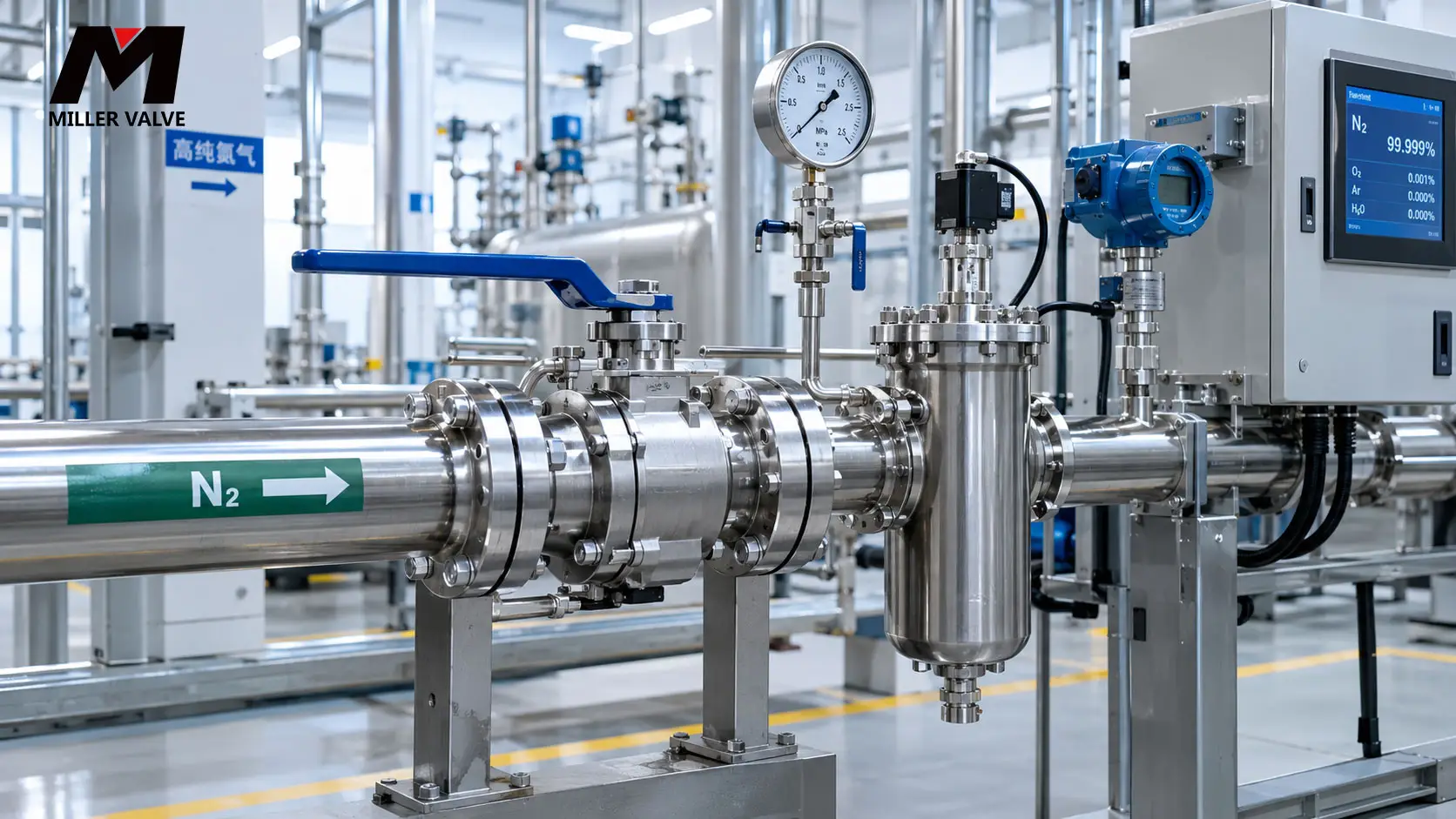
High-purity nitrogen appears to be a low-risk industrial medium. It is colorless, odorless, nonflammable, and does not support combustion. Once it enters chemical, electronics, pharmaceutical, food, metalworking, or tank-blanketing systems, however, the real challenge is not fire. The challenge is maintaining purity, detecting leaks, preventing moisture and particle contamination, and protecting personnel from oxygen-deficient atmospheres.
Ball valves in nitrogen piping are normally used for isolation, line switching, purging, and maintenance shutdown. Their construction may appear simple, but the cavity, stem seal, seat material, threaded connection, or internal leakage path can become an entry point for oxygen, moisture, particles, oil, and outside air. In high-purity, dry, or continuously supplied nitrogen systems, one unsuitable ball valve can undermine the performance of the entire generation, drying, and filtration train.
This article is not tied to a single fixed product specification. It examines nitrogen ball valve selection and operation from the perspective of the medium itself, including purity requirements, typical applications, purging, commissioning, monitoring, and maintenance. Pressure and temperature values mentioned here are intended to explain design principles. Final decisions should be based on the nitrogen specification, piping design data, applicable standards, and manufacturer verification.
1. What Makes High-Purity Nitrogen Piping Different?
1.1 Purity Is Not a Single Number
Industrial nitrogen specifications can include limits for oxygen, moisture, carbon dioxide, carbon monoxide, total hydrocarbons, particles, and oil. The priority changes with the application. Electronics and pharmaceutical systems often focus on moisture, particles, and organics. Chemical blanketing systems focus on oxygen content and supply reliability. Laser cutting and heat treating may place greater emphasis on pressure stability, flow capacity, and dew point.
| Contaminant or Condition | Typical Effect When Excessive | Ball Valve Design Area to Review |
|---|---|---|
| Oxygen | Oxidation, product variability, loss of protective atmosphere | External leakage, internal leakage, cavity retention, purge efficiency |
| Moisture | Corrosion, freezing, product contamination, high dew point | Drying, sealing, moisture absorption, purge path |
| Particles | Seat scoring, downstream contamination, instrument damage | Passage cleanliness, surface finish, dead zones |
| Oil | Catalyst, sensor, and product contamination | Oil-free assembly, lubricant choice, cleaning process |
| Total hydrocarbons and organics | High-purity process interference and odor issues | Seal outgassing, lubricant residue, cleaning residue |
| Pressure fluctuation | Unstable blanketing, poor flow measurement, process variation | Valve pressure drop, actuator response, pressure control |
The higher the nitrogen purity, the less tolerance the system has for small contamination sources. Sealant left in a threaded joint, an inadequately purged branch, or old gas trapped in a valve cavity can enter the downstream process during a changeover.
1.2 Nitrogen Is Inert, Not Harmless
Nitrogen displaces oxygen in the air. A leak or incomplete purge in a closed room, pit, valve box, tank, or pipe can create an oxygen-deficient atmosphere without any obvious odor or irritation. Personnel may lose judgment and consciousness before recognizing the hazard.
Nitrogen piping and valve design must therefore consider:
- Leaks cannot be found by smell alone.
- Even low-pressure nitrogen can accumulate in an enclosed space and reduce oxygen.
- Rapid release of high-pressure nitrogen can create jet, noise, and cold-temperature hazards.
- An isolated nitrogen section can increase in pressure when ambient temperature rises.
- Improper make-up or vent control in a tank blanketing system can cause overpressure or vacuum.
- Oxygen content, pressure status, and purge conditions must be confirmed before maintenance.
The chemical inertness of nitrogen does not replace mechanical integrity, leak control, ventilation, and safe work procedures.
1.3 Where Ball Valves Fit, and Where They Do Not
Ball valves are well suited to full-open or full-closed isolation and switching. They are not intended for long-term throttling at a small opening. In a typical industrial high-purity nitrogen system, ball valves can be used for:
| Task | Suitable? | Notes |
|---|---|---|
| Main line isolation | Yes | Requires reliable closure and verifiable position |
| Branch switching | Yes | Prefer full-open and full-closed positions |
| Flow control | Usually no | Use a control valve, pressure regulator, or needle valve |
| High-pressure-differential throttling | No | Causes noise, erosion, and particle generation |
| Sampling | Requires special design | A sampling valve, needle valve, or dedicated assembly is preferred |
| Ultra-high-purity point of use | Evaluate carefully | Diaphragm valves may be preferred in semiconductor and UHP gas systems |
For ultra-high-purity nitrogen, semiconductor-grade gas, or extremely clean service, a ball valve should only be used after review by the process and clean-gas specialists. A standard cavity and soft-seat ball valve is not automatically equivalent to a UHP gas valve.
2. Why Standard Ball Valves May Be Unsuitable for High-Purity Nitrogen
2.1 The Cavity Is a Retention and Purge Problem
Space exists around the ball, between the ball and seats, inside the body, and around the stem. After closure or switching, old gas, condensate, or particles can remain in these areas. Systems that require fast changeover and low residual contamination generally benefit from smaller cavity volume, a defined vent path, and a design that can be cleaned and purged effectively.
Cavity conditions also change with temperature and pressure. A trapped liquid or liquid-laden gas can expand when ambient temperature rises, so the relief path must be defined. Nitrogen is normally a gas, but condensation, liquid carryover, or droplets from a cryogenic vaporizer can make cavity behavior more complex.
2.2 Lubricants and Seals Can Become Contamination Sources
Stem packing, O-rings, seats, and assembly grease can release organic compounds. High-purity nitrogen service requires low-outgassing, low-permeation, and compatible materials. The specification should clearly state whether lubricant is permitted and which lubricant is approved.
| Component | Common General-Industrial Practice | High-Purity Nitrogen Review Point |
|---|---|---|
| Stem packing | General PTFE, graphite, or rubber packing | Outgassing, permeation, wear, and fugitive emissions |
| Seats | Standard PTFE, reinforced plastic, or rubber | Temperature, pressure, cold flow, and particle release |
| Assembly lubricant | General anti-seize or grease | Oil-free or approved lubricant to protect downstream purity |
| Threaded joints | PTFE tape or sealant | Thread cavities, debris, and sealant residue |
| Body surfaces | Standard machining and cleaning | Degreasing, passivation, rinsing, and drying |
Without a defined cleanliness class and material compatibility review, general grease, PTFE tape, and standard sealant should not be introduced into high-purity nitrogen piping.
2.3 External and Internal Leakage Have Different Consequences
External leakage releases nitrogen into the surrounding area, creates an oxygen-deficiency risk, wastes supply gas, and can allow moisture to enter the system. Internal leakage can pressurize an isolated section, reduce downstream purity, or allow air, moisture, and particles to pass through an incompletely sealed seat.
Leak testing should not rely only on bubble observation. Depending on purity, pressure, and site safety requirements, high-purity nitrogen systems may use pressure decay testing, helium mass spectrometer leak detection, oxygen monitoring, or dew point monitoring.
2.4 Threaded and Flanged Connections Create Cleanliness Risks
Threaded joints contain crevices where sealant and tape can generate debris. Flanged connections are easier to dismantle, but gasket material, bolt holes, and sealing surfaces can trap moisture and particles. High-purity nitrogen systems often favor welded, metal-sealed, or dedicated high-purity connections, with verified removable joints only where maintenance requires them.
| Connection Type | Advantages | High-Purity Nitrogen Risk | Recommended Use |
|---|---|---|---|
| Welded | Fewer leak points and high cleanliness | Difficult maintenance and high weld-quality requirement | Continuous piping and hard-to-service locations |
| Flanged | Easy to dismantle | Gasket outgassing and dirt in bolt holes | Locations requiring periodic maintenance and inspection |
| Threaded | Low cost and quick installation | Crevices, sealant, and tape residue | General low-pressure utility lines; use with caution in high-purity sections |
| Compression fitting | Convenient for small lines | Assembly quality affects leakage and particles | Only where system design and materials permit |
| Dedicated high-purity fitting | Clean, removable, and controllable leakage | Higher cost and spare-part requirements | Electronics, pharmaceutical, and UHP gas systems |
3. Key Design Choices for Nitrogen Ball Valves
3.1 Body, Ball, and Stem Materials
Stainless steel piping is common in high-purity nitrogen service. Grade 304, 316, and 316L may all appear in industrial gas systems. Grade 316L is often selected for improved corrosion resistance, low carbon content, and welding compatibility in more demanding piping. Final material selection should consider pressure, temperature, external environment, and the project cleanliness specification.
| Material | Typical Advantages | Points to Confirm |
|---|---|---|
| 304 stainless steel | Moderate cost and general corrosion resistance | Chloride and high-temperature service require separate review |
| 316 stainless steel | Better corrosion resistance than 304 | Welding, cleaning, and surface treatment still require verification |
| 316L stainless steel | Low carbon, suitable for welding and higher cleanliness requirements | Higher cost and tighter process control |
| Carbon steel | High strength and lower cost | Difficult to maintain internal cleanliness and rust control |
| Specialty alloy | For special corrosion or low-temperature service | Lead time, cost, and material compatibility |
For high pressure, large size, or low operating torque, a trunnion-mounted ball valve often has an advantage over a floating-ball design. Small-diameter and low-pressure systems may use a floating ball. Selection should consider pressure class, operating frequency, and actuator output, not only nominal size.
3.2 Soft and Metal Seats
Soft-seated ball valves generally provide good sealing in low-to-moderate pressure service, but temperature, particles, and material outgassing can limit their range. Metal seats are often better suited to high temperature, high pressure, and repeated thermal cycling, but usually require higher operating torque. Leakage performance must be evaluated under the stated test conditions.
| Seat Type | Typical Application Direction | Operating Considerations |
|---|---|---|
| PTFE or reinforced PTFE | Ambient, clean, low-differential service | Cold flow, outgassing, temperature limit, and particle scoring |
| PFA or PCTFE | Higher-purity or low-temperature service | Permeation, cost, and installation damage |
| Metal-to-metal | High temperature, high pressure, particles, or thermal cycling | Torque, surface quality, and leakage class |
| Combination seat | Balance of sealing and wear resistance | More complex construction and matched spare parts |
For high-purity nitrogen, the question is not only whether the seat material is compatible with nitrogen. It is also whether the material can outgas, swell, cold-flow, or generate particles at the operating temperature and pressure.
3.3 Stem Sealing and Fugitive Emissions
The stem is the most common dynamic sealing location in a ball valve. Packing compression, stem surface finish, thermal cycling, and operating frequency all affect emissions. Systems with continuous supply, enclosed installation space, or high-purity requirements should use a low-emission design and retain access for inspection and replacement.
Stem seal review points include:
- Compatibility of packing with nitrogen, moisture, and the external environment.
- Packing compression change from ambient to low or high temperature.
- Stem scoring caused by side loading, corrosion, or particles.
- Radial load created by manual operation or actuator alignment.
- Isolation, shutdown, and purge requirements when packing is replaced.
3.4 End Connections and Installation Orientation
High-purity nitrogen piping should minimize unnecessary removable joints while retaining access for required maintenance and sampling. Valve orientation should consider cavity drainage, stem position, actuator removal space, and pipe stress.
For valves with drain or vent ports, confirm:
- Whether the port can be isolated from the nitrogen system.
- Whether the discharge location is safe and will not create an oxygen-deficient area.
- Whether the cavity can be overpressured by temperature change.
- Whether the vent line requires filtration, a check valve, or recovery.
- Whether the port can be operated accidentally.
4. Typical Industrial High-Purity Nitrogen Applications
4.1 Chemical and Petrochemical Blanketing and Purging
Tanks, reactors, centrifuges, and piping are often purged or inerted with nitrogen before startup, shutdown, or maintenance. Ball valves normally provide isolation, switching, and shutoff. They should not be used for long-term nitrogen flow control.
Key design issues include:
- Whether nitrogen pressure can protect the process without overpressuring the tank.
- Whether process fluid can back up into the isolated nitrogen section.
- How the tank breather, nitrogen make-up valve, and vent valve are interlocked.
- Whether double isolation is required for maintenance.
- Whether oxygen sample points represent the worst-case location.
4.2 High-Purity Gas Distribution in Electronics, Pharmaceuticals, and Food
These applications may have strict requirements for moisture, particles, oil, and microbiological control. Valves must meet the applicable cleanliness, cleaning, and material requirements. Piping should minimize dead legs and removable joints. UHP points of use may require diaphragm valves, bellows valves, or dedicated high-purity valve assemblies instead of standard ball valves.
4.3 Laser Cutting and Metalworking
Laser cutting assist gas requires stable pressure, sufficient flow, and a low dew point. Ball valves are normally used for source isolation and branch switching. Pressure and flow are controlled by regulators, proportional valves, or dedicated control valves. A partially open ball valve can cause unstable pressure and velocity and may increase particle generation.
4.4 Tank and Pipeline Nitrogen Protection
Long-term blanketing requires reliable sealing. Internal leakage wastes nitrogen and can allow air to enter a tank through an incompletely sealed path. In systems exposed to vacuum risk, rapid nitrogen make-up or restricted venting can deform the tank.
4.5 Pipe Drying, Purging, and Commissioning
Newly installed or overhauled nitrogen piping must be cleaned of weld slag, moisture, and air. Valves should be included in the purge-path design and must not become accumulation points for contamination. After welding, the system should be rinsed or cleaned as required, dried, leak-checked, and verified for nitrogen purity.
4.6 Gas Delivery After Cryogenic Nitrogen Vaporization
The gas temperature after liquid nitrogen vaporization can be lower than ambient. Valves, flanges, and seals must be suitable for low temperature and cannot be selected only from ambient-temperature catalog data. Soft seats may harden, contract, and leak more readily at low temperature. Metal seats or a cryogenically verified design may be required.
5. Nitrogen Ball Valve Specification Checklist
5.1 Define the Medium and Purity First
| Parameter | Required Information |
|---|---|
| Nitrogen purity | Allowable oxygen, moisture, particles, oil, and total hydrocarbons |
| Medium condition | Ambient gas, cold gas, gas with liquid droplets, or high-pressure gas |
| Pressure and temperature | Design pressure, maximum working pressure, ambient temperature, and medium temperature |
| Flow and pressure drop | Maximum flow, allowable pressure drop, and pressure stability |
| Operation | Manual, pneumatic, electric, on/off, or modulating |
| Shutoff requirement | Leakage class, sealing direction, and need for double block and bleed |
| Cleanliness | Cleaning, degreasing, drying, packaging, and particle control |
| Environment | Indoor, outdoor, confined space, corrosion, and vibration |
5.2 Select the Ball Valve Construction
| Service Direction | Typical Construction Preference | Reason |
|---|---|---|
| Small size, low pressure, lower cost | Floating ball, soft seat | Simple construction and easy maintenance |
| Large size, high pressure, frequent operation | Trunnion ball, low-torque design | Pressure load is carried by the support structure |
| High temperature or particles | Metal-to-metal seat | Temperature and wear resistance |
| High purity and low outgassing | Low-outgassing seals and clean processing | Reduces particles and organic contamination |
| Cavity venting required | Drain or vent port | Supports purging and pressure verification |
| Safety interlock | Pneumatic or electric actuator | Remote operation and fail-safe requirements |
5.3 Actuator Selection Is More Than Torque Calculation
Actuator selection for nitrogen service should consider maximum differential pressure, seat friction, hot or cold torque, air quality, and fail-safe position. Oil- or moisture-laden instrument air can introduce contamination and may freeze in low-temperature environments. Electric actuators require power, control signal, hazardous-area, and overload protection review.
Confirm:
- Whether the valve opens, closes, or holds position after air or power loss.
- Whether stroke time affects process pressure and purity.
- Whether position feedback represents the actual ball position.
- Whether local manual operation is required.
- Whether explosion protection, corrosion protection, or low-temperature protection is required.
6. Installation, Purging, and Commissioning
6.1 Cleanliness Inspection Before Installation
Before installation, confirm that the valve cavity is clean, the ports remain sealed, the seals are undamaged, and the nameplate data match the specification. Packaging debris, dust, and metal particles must not enter a high-purity nitrogen system.
| Inspection Item | Recommended Practice | Consequence of Failure |
|---|---|---|
| Internal cavity | Check for rust, dust, and foreign material | Particles enter downstream equipment |
| Seals | Verify material and cleanliness | Outgassing, leakage, or swelling |
| Ports | Keep sealed before installation | Moisture and particles enter the valve |
| Nameplate | Verify pressure, temperature, size, and material | Use outside the intended pressure or temperature range |
| Packaging | Use clean packaging and clean tools | Secondary contamination during installation |
6.2 Pipeline Purging and Displacement
After installation, the high-purity nitrogen piping should be purged, dried, and verified according to the approved procedure. The purge medium should be dry, oil-free nitrogen or another approved medium. General compressed air should not be used if it could contaminate the system.
A typical purge and displacement sequence includes:
- Confirm that valves are in the correct open or closed position for the purge direction.
- Use a dry medium to remove particles and construction residue.
- Use vacuum and pressure cycles, or an approved continuous purge method.
- Pay particular attention to low points, branches, and valve cavities.
- Measure oxygen content, dew point, and particles.
- Connect the system to process equipment or the high-purity downstream only after acceptance criteria are met.
6.3 Do Not Substitute a Water Hydrotest for a Cleanliness Check
If a water hydrotest is required, the system must be drained, dried, and checked for sealing and moisture afterward. For clean nitrogen piping that must not contact liquid water, a risk-assessed gas test or dry inspection method should be used where acceptable.
6.4 Avoid Rapid Pressurization During Initial Startup
Rapid pressurization can shock valves and seals and can carry pipe particles into branch lines. Increase pressure slowly during initial startup and inspect the stem, flanges, welds, and vent ports. If an abnormality appears, stop the pressure increase instead of continuing to pressurize in an attempt to judge the seal.
7. Monitoring and Maintenance
7.1 Monitor Trends, Not Only Current Values
| Monitoring Point | Purpose | Abnormal Direction |
|---|---|---|
| Supply pressure | Indicates system resistance and supply stability | Pressure drop or increased fluctuation |
| Nitrogen flow | Identifies leakage and abnormal demand | High flow during non-production hours |
| Oxygen content | Indicates whether air has entered the nitrogen system | Increasing oxygen |
| Dew point or moisture | Indicates dryer condition | Increasing dew point |
| Particle count | Shows contamination trend in high-purity systems | Increasing particles |
| Valve position feedback | Confirms actual valve state | Feedback does not agree with flow |
| Ambient oxygen | Indicates whether leakage has reduced oxygen in the area | Decreasing oxygen |
7.2 Select an Appropriate Leak Detection Method
Nitrogen has no color or odor, so leakage cannot be found by smell. Available methods include:
- Pressure decay testing.
- Helium mass spectrometer leak detection.
- Oxygen monitoring.
- Ultrasonic leak detection.
- Dedicated high-purity leak detection methods approved for the system.
Soap bubble solution should not be the only leak detection method in a high-purity nitrogen system. Liquid can enter sealing surfaces, threads, and insulation and create secondary contamination.
7.3 Isolate and Purge Before Maintenance
Before dismantling a nitrogen ball valve, stop the nitrogen source, isolate the relevant pipe section, release pressure, and remove the oxygen-deficiency risk with air or another approved medium. Do not omit purging and oxygen measurement simply because nitrogen is described as non-toxic.
After maintenance, inspect:
- Ball orientation and valve position.
- Seat, stem, and connection leakage.
- Actuator operation and limit settings.
- System purge and dew point.
- Downstream oxygen content and purity.
- Valve torque and stroke time.
8. Nitrogen Piping Safety Risks
8.1 Oxygen Deficiency Is the Most Underestimated Risk
When nitrogen leaks into a closed room, oxygen concentration falls. Personnel may lose judgment within a short time. Nitrogen areas should have ventilation, oxygen monitoring, alarms, and clear signs. Valve maintenance and vent operations should follow confined-space and oxygen-deficiency work requirements.
8.2 Isolated Sections Can Become Overpressured
After both ends of a pipe section are closed, residual nitrogen can increase in pressure as ambient temperature rises. For liquid-containing or potentially liquid-containing sections, evaluate thermal expansion and relief paths. Safety relief, drain, or pressure-reduction facilities may be required.
8.3 Cold Gas Can Cause Frostbite
Cold nitrogen gas or gas from a liquid nitrogen vaporizer can frost valve and pipe surfaces. Personnel should use suitable protective equipment and avoid direct contact with cold surfaces. Low-temperature materials, seals, and bolt preload require specific review.
8.4 High-Pressure Gas Creates Jet and Noise Hazards
High-pressure nitrogen passing through a small opening or leak creates a high-velocity jet that can generate noise, mechanical injury, and local cold temperature. A standard ball valve should not be used as a long-term throttling or venting device. Never attempt to stop a leak with a hand or general-purpose tool.
9. Common Misconceptions and Selection Checklist
9.1 Eight Common Misconceptions
Misconception 1: Nitrogen is inert, so the valve cannot create a safety problem.
Nitrogen can cause oxygen deficiency and can pressurize an enclosed volume. The safety risk is significant.
Misconception 2: A stainless steel standard ball valve is suitable for high-purity nitrogen.
Material is only the starting point. Cleaning, sealing, lubrication, and surface treatment are equally important.
Misconception 3: A ball valve can control nitrogen flow at any opening.
Standard ball valves are intended for isolation and switching. Long-term partial opening causes erosion, noise, and particles.
Misconception 4: No odor means there is no leak.
Nitrogen is colorless and odorless. Leakage must be identified through pressure, flow, oxygen monitoring, and leak detection.
Misconception 5: Internal leakage only wastes nitrogen.
Internal leakage can also increase downstream pressure, reduce purity, or allow air to flow backward.
Misconception 6: A high-purity system can be assembled first and cleaned entirely by purging.
Oil, particles, and moisture introduced during installation may be difficult to remove. Cleanliness begins with selection and assembly.
Misconception 7: Standard ball valves can be used at every ultra-high-purity gas terminal.
Semiconductor, electronics, and UHP gas systems may require diaphragm valves, bellows valves, or dedicated high-purity construction.
Misconception 8: If there is no leak, the system is ready for service.
Valve position, actuator operation, oxygen content, dew point, particles, and system displacement must also be confirmed.
9.2 Nitrogen Ball Valve Selection Checklist
| Check | Question |
|---|---|
| Purity | What are the allowable oxygen, moisture, particle, oil, and hydrocarbon limits? |
| Medium | Is it ambient gas, cold gas, or gas with liquid droplets? |
| Pressure | Are design pressure, maximum differential pressure, and sealing direction defined? |
| Temperature | Do medium and ambient temperatures cover every operating condition? |
| Material | Are body, ball, stem, and seals compatible? |
| Cleanliness | Are degreasing, passivation, cleaning, drying, and packaging required? |
| Connection | Is the system welded, flanged, threaded, or using dedicated high-purity fittings? |
| Sealing | Do soft, metal, or combination seats meet the requirement? |
| Actuator | Are manual, pneumatic, or electric operation and fail-safe position defined? |
| Venting | Are cavity drain, vent, and relief paths safe? |
| Testing | How will external leakage, internal leakage, purity, and displacement be verified? |
| Maintenance | Are spare parts, tools, and post-assembly cleanliness requirements prepared? |
10. Ball Valves and Other Valve Types
High-purity nitrogen systems rarely use only one valve type. Ball valves provide fast, low-pressure-drop isolation and switching. Other valve types may be more suitable for flow control, sampling, UHP terminals, and backflow prevention.
| Valve Type | Better Suited To | High-Purity Nitrogen Consideration |
|---|---|---|
| Ball valve | Full-open and full-closed isolation, branch switching, fast shutdown | Cavity retention, soft-seat outgassing, and partial-opening erosion |
| Globe valve | Small-flow control, throttling, and pressure control | Higher pressure drop; cavity and packing must meet cleanliness requirements |
| Needle valve | Sampling, instrument lines, and fine flow adjustment | Small passages are more sensitive to particles and plugging |
| Diaphragm valve | High-purity, UHP, low-residue, and clean isolation | Confirm diaphragm life, temperature, and permeation |
| Bellows valve | Low-emission, hazardous, or high-purity gas isolation | Evaluate bellows fatigue, stroke, and replacement requirements |
| Check valve | Preventing nitrogen or process fluid backflow | Cracking pressure, sealing, and installation direction must match |
| Pressure regulator | Stable pressure reduction from a high-pressure source to the point of use | Freezing, noise, downstream overpressure, and pressure fluctuation |
In a blanketing system, a common combination is a ball valve for isolation, a regulator for pressure control, a needle valve for sampling, and a check valve for backflow prevention. Assigning all functions to one ball valve makes purity difficult to guarantee and can cause early valve wear.
10.1 A Ball Valve Is Not a Pressure or Flow Controller
High-pressure nitrogen normally passes through a pressure regulator before reaching the point of use. Throttling a standard ball valve at a small opening increases velocity, noise, and particles and can make downstream pressure unstable. Use a regulator, control valve, or dedicated flow-control element when stable flow is required.
10.2 A Ball Valve Does Not Replace Every UHP Diaphragm Valve Function
Some semiconductor, electronic specialty gas, and pharmaceutical terminals require a very small cavity, no dead zones, low outgassing, and repeatable cleaning. A ball valve offers fast shutoff, but its cavity and seat clearances may not meet UHP requirements. Diaphragm valves, bellows valves, or a qualified high-purity valve assembly may be required.
10.3 Backflow Protection Requires a Separate Review
After a nitrogen system is closed, process pressure can exceed nitrogen pressure and force process fluid backward. A standard ball valve may not protect the nitrogen side in the required direction. A check valve, double block and bleed arrangement, or another isolation method may be required.
11. Conclusion and Recommendations
The core requirement of a high-purity nitrogen system is not simply to install a ball valve. The valve must be matched to nitrogen purity, pressure, temperature, cleanliness, oxygen-deficiency safety, and maintenance conditions. Because nitrogen is nonflammable, colorless, and odorless, designers cannot rely on sensory observation or general experience.
In chemical, pharmaceutical, electronics, food, and metalworking applications, ball valves are suitable for reliable isolation and switching. They should not be treated as flow-control valves or universal UHP gas valves. Define purity, dew point, pressure, and cleanliness first. Then confirm body construction, seat material, connection type, actuator, and vent path. Finally, verify the system through purging, leak testing, and commissioning.
Each valve should also be included in a nitrogen piping asset register with its location, material, seal batch, cleanliness status, commissioning date, leak test result, and maintenance history. Review leakage, purity, particles, and valve operating trends periodically. Isolation valves that remain idle should be function-tested according to risk. Regulators, check valves, and pressure-relief devices should be inspected with the ball valves so that one healthy component does not hide a weak system.
About MILLER
MILLER provides industrial fluid-control products and valve selection support for a range of gas, liquid, and process applications. A nitrogen-specific configuration should be confirmed against the project data sheet, purity requirements, and manufacturer review. General catalog data for water, steam, or slurry valves should not be applied directly to high-purity nitrogen service.