Ask most people to name a hard valve application and they'll say superheated steam. Ask them about cold, and they picture something easy — refrigeration, maybe, where temperatures are mild and pressures are low.
Then they meet an LNG terminal.
Liquid natural gas sits around −162 °C. Liquid oxygen is colder still, around −183 °C, and liquid nitrogen goes to −196 °C. In that range, none of the usual intuitions hold. Steel behaves differently.
Seals stop acting like seals. And if the line is also under high pressure — which it usually is, because you spend energy compressing the gas before you cool it — you're asking one valve to survive two unrelated problems at once.
Why the combination is harder than either problem alone
Cold alone is manageable. Pressure alone is routine. Together, they attack the valve from two directions.
Pressure wants the valve to be strong and thick-walled. It wants heavy flanges, a rigid body, and enough bolt preload to hold a joint closed against a strong internal force.
Cold wants everything to shrink. And it doesn't shrink uniformly. A body casting, a forged stem, and a disc are three different shapes in possibly three different materials. At −162 °C, they contract by different amounts, and the bolt preload you carefully set at room temperature is no longer the preload you have in service.
That's the core difficulty. Not strength — fit. Parts that fit in the workshop stop fitting at temperature, and the gap that opens up is a leak path.
Then there's the smaller, meaner problem. The air around a cold pipe is full of water vapour. That vapour condenses on your valve stem and freezes. A little ice in a packing box is annoying. Enough ice, and the stem stops moving when you need it to move.
What a cryogenic, high-pressure valve does differently
Three design decisions separate a cryogenic valve from a general-purpose one:-
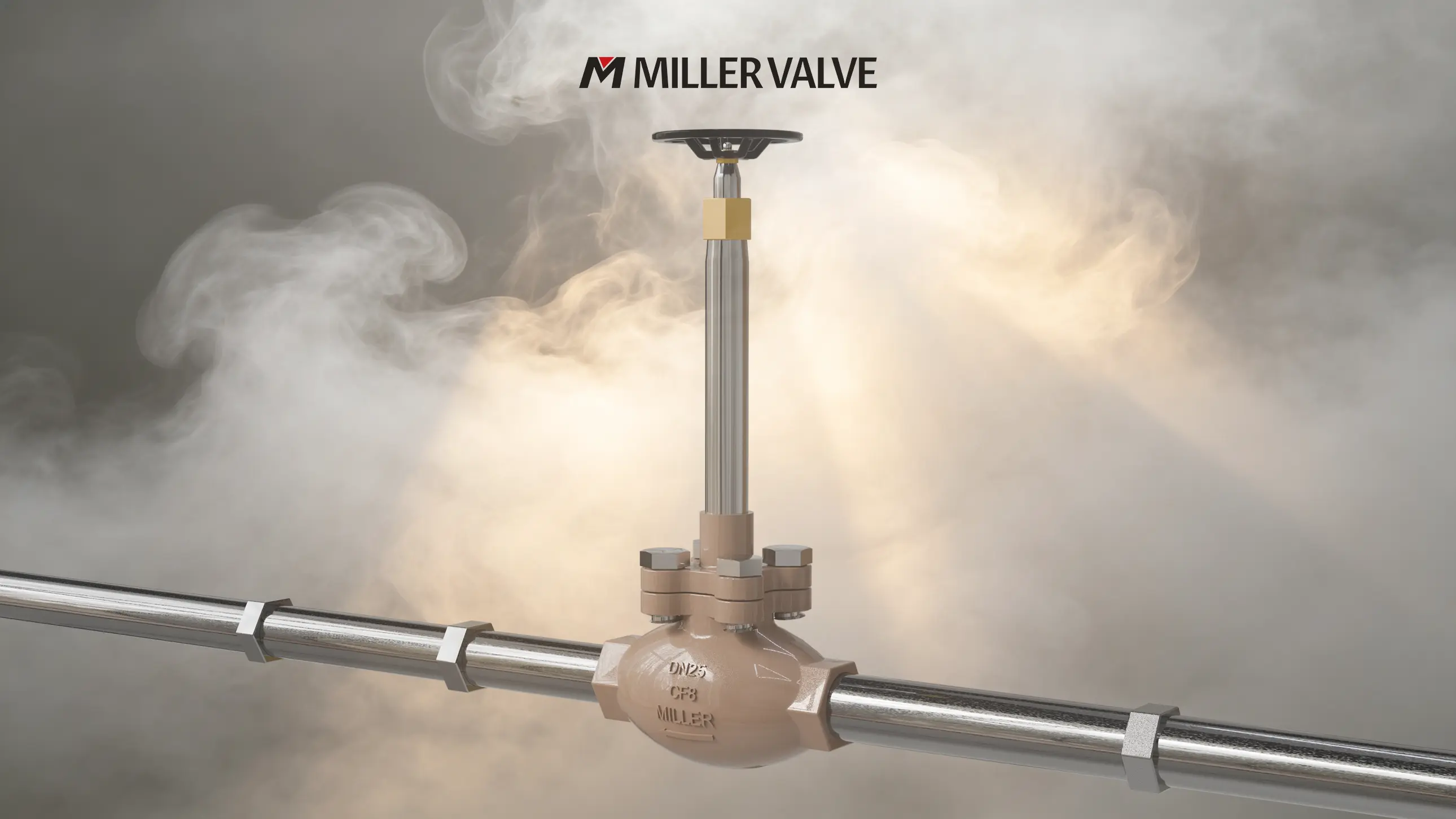
the long neck. Cryogenic valves have a distinctly elongated bonnet. It isn't cosmetic and it isn't a heat-loss feature. That extra length pushes the packing and the operating mechanism out of the cold zone, so the stem seal sits in reasonably normal temperatures while the working end sits in cryogenic ones. The length is governed by recognized practice — MSS SP-134 covers extended bonnets for cryogenic service.
-
hard seats instead of soft ones. Most soft sealing materials stop behaving well below roughly −100 °C. They go brittle, lose resilience, and stop sealing. Cryogenic valves typically use a metal-to-metal or hard-faced seat — often a carbide or hardfacing alloy — because hardness doesn't care how cold it is.
-
materials chosen for toughness, not strength.At low temperature, ordinary carbon steel enters its brittle range, generally accepted to begin around −29 °C, and cracks instead of deforming. So cryogenic construction moves up through low-alloy and nickel steels into austenitic stainless — 304, 316 and their cast equivalents — which stays ductile all the way down.
The one number worth remembering:below about −29 °C, check the material, not just the pressure rating. A valve can be rated for the pressure and still be wrong for the temperature.
Which valve for which cold-service job
Here's where the answer depends entirely on what the valve has to do. Cold and high pressure describe the conditions; the valve type is set by the function:
For isolation — the cryogenic globe valve
Most cryogenic isolation points want a valve that shuts off completely and stays shut. Miller's M40P cryogenic globe valve is built for exactly this. It's rated from −196 °C up to +80 °C and covers Class 150 through Class 2500, so it spans both the coldest media and genuinely high pressures in one product line. The seat is metal, backed by an reinforced packing arrangement, and it handles LNG, LPG, liquid oxygen, and liquid nitrogen. Connections can be flanged, threaded, or welded — welded is usually the better choice where thermal cycling is frequent, because there's no gasketed joint to relax.
If you're isolating a tank outlet or a pump suction in cold service and you want one valve that closes properly, this is the straightforward answer.
For keeping flow one-way — the cryogenic check valve
Cold lines have a particular problem with reverse flow. When a pump stops, or when a warm section flashes off, the Miller's U32 check valve addresses this in a way that suits cold duty: it's available in lift and swing configurations, so the closing action can be matched to the flow pattern rather than forced, and it uses a hard-faced carbide seat with ANSI Class VI sealing. It's rated across −196 °C to +610 °C, which makes it unusual — one product covering both cryogenic and high-temperature service. Body material options run from carbon steel through 304/316 and into F11, F91, and CF3M, so it can be matched to the medium rather than just the temperature.
For LNG, liquid oxygen, or liquid nitrogen containment where a reversal would be genuinely bad, this is the piece to look at.
For large lines — and a limit worth knowing
Small-bore isolation and check duty are well covered by cryogenic globe and check valves. Large-diameter lines are a different problem, because globe valves become heavy and expensive as they grow.
For big cold-service lines, a butterfly valve is usually the practical answer. Miller's KF70D pneumatic triple-offset butterfly valve offers a triple-offset design that eliminates seat friction during the stroke, a hard seal rated to ANSI Class VI, and a broad pressure range up to Class 1500. It's offered in sizes up to DN3000, which is a different order of magnitude from a globe valve.
But here's the honest limit: the KF70D's temperature range starts at −120 °C. That's fine for a lot of industrial refrigeration, LPG storage, and cold process work. It is not enough for LNG, liquid oxygen, or liquid nitrogen.
So the rule is simple. If your medium is colder than about −120 °C, don't specify a standard butterfly valve — go to a purpose-built cryogenic design. If it's warmer than that but still genuinely cold, and the line is large, a triple-offset butterfly valve is a strong choice.
Three habits that save cryogenic valves
The equipment is only half the story. Three field practices matter as much as the specification.
Cool down slowly: Pouring cryogenic liquid into a warm valve is the single fastest way to damage a seat. A staged cool-down lets each component reach temperature in sequence instead of fighting its neighbours.
Keep the stem dry: Frost and ice on an exposed stem turn a routine operation into a fight. Stem protection exists for a reason.
Have a written answer for what happens when things stop: If the actuator loses air or power in cold service, what should the valve do — open, close, or hold? A spring-return actuator is simpler and fails to a defined position. A double-acting actuator holds position but needs its air supply to keep doing so. Neither is inherently better; the process decides.
A quick summary
Cold and pressure together attack the fit between parts, not just the strength of them. Cryogenic valves answer that with an extended bonnet to move the seal out of the cold, hard seats that don't care about temperature, and austenitic stainless that stays ductile where carbon steel would crack.
Then match the valve to the job: M40P for isolation, U32 for one-way flow, and KF70D for large high-pressure cold lines — remembering that the butterfly stops at −120 °C, so anything colder needs a purpose-built cryogenic valve.
If you're working through a specific cold-service application, Miller Valve's selection centre lists the full range with the current published ratings